Early feasibility study
RecruitingNeuralink's first study of the N1 implant and R1 surgery robot. It looks at safety and at how well people can control digital devices. It runs under the same main plan in several countries.
Telepathy aims to enable people living with paralysis to control their computers using only their thoughts.
The Neuralink listens to the part of the brain that controls the hand.
Participants learn to control a cursor through simply imagining moving their hand.
These imagined motions are then calibrated into computer mouse actions.
Through their mind-controlled mouse, participants are able to fully operate their computer.
From messaging friends and family to watching videos, writing code, 3D modeling, creating art, and gaming, participants use the Neuralink to restore digital independence.
Neuralink has given me back parts of my life that I thought were lost forever.
 Noland ArbaughNeuralink participant

We are looking for individuals who:
There is no cost to participate. The study device, surgery, and study-related visits are provided at no charge, and travel and lodging for visits to the study site are supported.
Currently, Neuralink participants are generally able to navigate a cursor and execute three clicks (left, right, and middle), mimicking a computer mouse.
Performance of the cursor may vary across participants with some participants achieving performance comparable to able-bodied control.
While some participants test experimental features such as keyboard, game console, wheelchair, and robotic arm control, these features are not currently available for all participants.
The learning curve of Telepathy varies. Some participants are able to gain fluent control on their first day while others may take a few weeks. During this onboarding phase, the Neuralink team is closely involved to support the participant as they learn to use the device. Additionally, maintaining cursor control may require up to a few hours of calibration per week.
The Neuralink implant currently primarily operates on a MacBook that will be provided to participants. The ability to control devices such as a phone, Windows computer, or gaming console are still being developed and not currently available for all participants.
No. The Neuralink implant sits flush within the skull, and the electrode threads are inside the brain. There are no wires, no connectors, and no external battery pack. Once the incision heals and your hair grows back, nothing is visible.
The implant talks to your computer wirelessly and charges wirelessly through the scalp, so there is nothing to plug in and nothing to wear during the day.
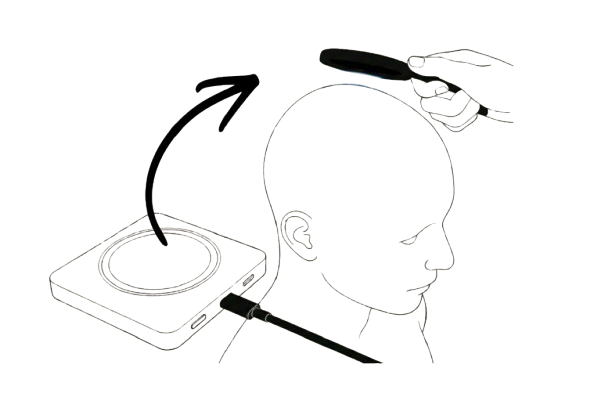
The Neuralink is charged wirelessly by placing the charger handle near the area of the implant. For convenience, participants are provided headwear (such as a hat) that house a pouch to store the charger handle.
For every one hour of charge, the Neuralink implant can be used for 4-8 hours (depending on the implant version). The device can be used continuously while charging.
Neuralink's first study of the N1 implant and R1 surgery robot. It looks at safety and at how well people can control digital devices. It runs under the same main plan in several countries.
Neuralink devices are investigational and have not been approved by the FDA or other regulatory authorities. Testimonials are from voluntary clinical trial participants sharing their personal experiences, which may not reflect all participants or future outcomes.
If you have limited use of your hands due to spinal cord injury, ALS, or brain stem stroke, tell us about yourself in a few minutes.
Submit Interest Form (opens in a new tab) Canada
 United Kingdom
 United States