A Year of Telepathy
In January 2024, Noland became the first person to receive a Neuralink implant.
The implant, or Link, is our fully implantable, cosmetically-invisible, wireless brain-computer interface (BCI) designed to restore autonomy to people with paralysis. It enables users to operate their phones and computers with just their thoughts, a capability we call “Telepathy.”
Today, there are three people with Telepathy: Noland, Alex, and Brad.
All three individuals are unable to move their arms and legs—Noland and Alex due to spinal cord injury (SCI) and Brad due to amyotrophic lateral sclerosis (ALS). They each volunteered to participate in Neuralink’s PRIME Study,* a clinical trial to demonstrate that the Link is safe and useful in the daily lives of people living with paralysis.
Combined, the PRIME Study participants have now had their Links implanted for over 670 days and used Telepathy for over 4,900 hours. These hours encompass use during scheduled research sessions with the Neuralink team and independent use for everyday activities. Independent use indicates how helpful the Link is for real-world applications and our progress towards our mission of restoring autonomy. Last month, participants used the Link independently for an average of 6.5 hours per day.
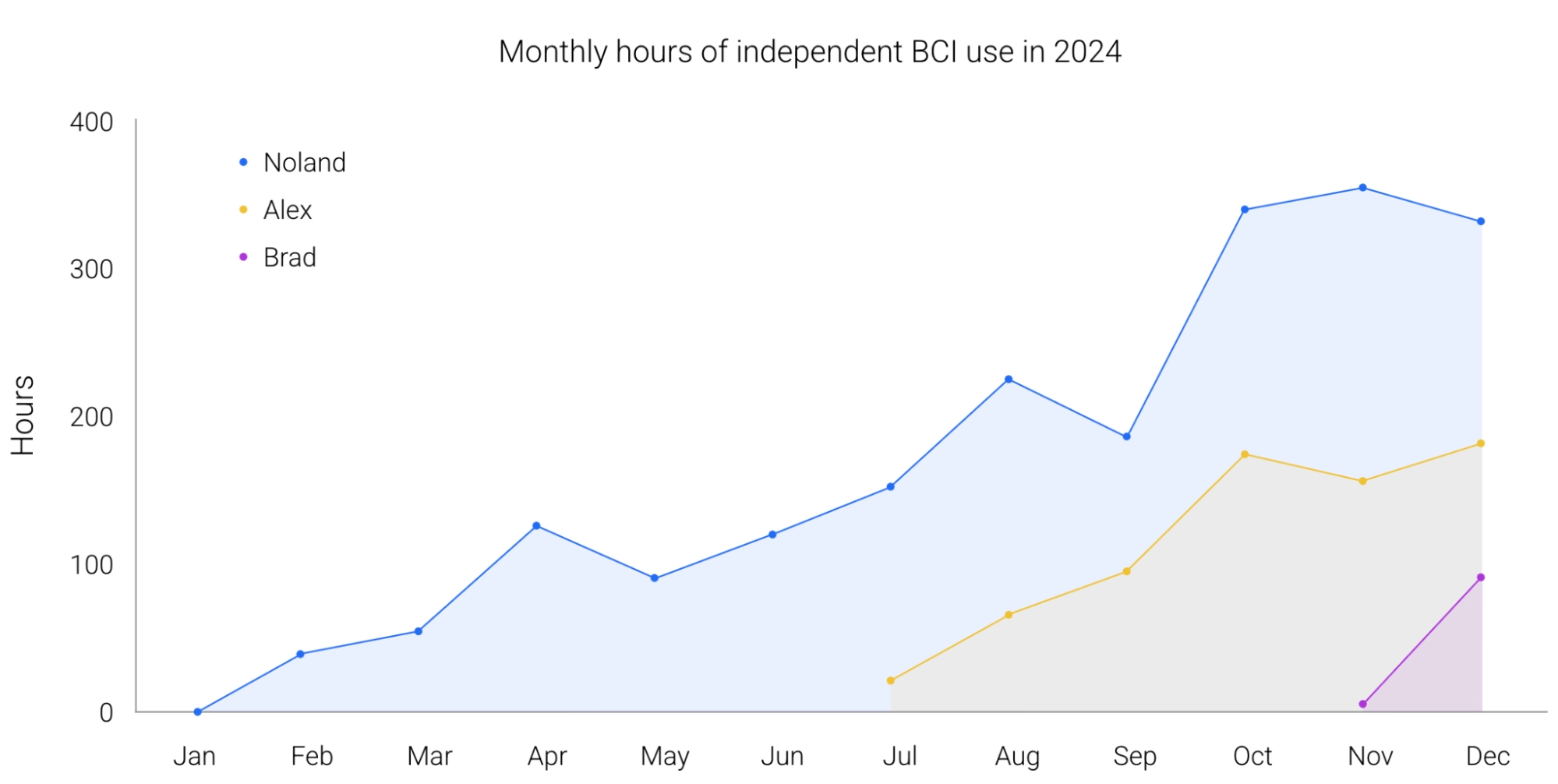
We are incredibly grateful for these three pioneers who have volunteered to participate in the PRIME Study and are helping redefine the boundaries of human capability. We are excited to share an update on their experiences so far.
Noland
“[The Link] has helped me reconnect with the world, my friends, and my family. It's given me the ability to do things on my own again without needing my family at all hours of the day and night.”
— Noland
Last year, we published a video giving a glimpse into Noland’s ability to interface with digital devices before and after receiving his Link.
The summer before his last year in college, Noland suffered a spinal cord injury in a swimming accident and became paralyzed below his shoulders. As a result, he was unable to complete his degree and returned home where he had to rely on his family to support his everyday needs.
Noland spent most of his days in bed. His primary digital device was a tablet which he controlled using a mouth-held stylus (mouth stick). The mouth stick not only caused discomfort and fatigue after prolonged use, but it also had to be put in place by a caregiver, which limited when and how long he could use his tablet. This was one of many challenges he faced as he adjusted from being an independent college student to relying on others for daily tasks.
After almost a decade of feeling limited by his injury, Noland decided to participate in the PRIME Study and received a Link. He is now able to control a cursor with his thoughts to browse the internet, play games, and continue his educational journey with greater independence. He has maintained a rigorous daily schedule dedicated to exploring a diverse range of subjects, from mathematics and philosophy to foreign languages and creative writing. With the Link, he can operate his digital devices in his own time and has even pushed himself to use Telepathy continuously throughout a 72-hour live stream on X.
“Before, my learning was just watching YouTube. That's not what I'm doing anymore. I’m able to use different apps to do more interactive and hands-on things online. I feel like I'm learning a lot more…I work and learn from sun up to sun down. This is not something I would be able to do without the Neuralink.”
— Noland
Noland plays Polytopia using the Link during a 72-hour live stream on X.
Noland’s one-year anniversary with the Link represents a significant milestone for the PRIME Study and he has continued to use Telepathy with a sense of optimism about how it may help in the future.
“I'm trying to get back to school… I'm also considering trying to find work and be a productive member of society again.”
— Noland
Alex
“I was a very creative person before my accident. After my accident, I wasn't really able to do that, [and] it really hindered my drive to create things… Having the BCI… allows me to push the boundaries of what I can create.”
— Alex
Before his injury, Alex enjoyed designing and building automobile parts. After a car accident a few years back, he became paralyzed from the neck down, losing his ability to create designs.
With his new ability to reliably use a computer via Telepathy, Alex now designs 3D objects using computer-aided design (CAD) software and designs graphics on Adobe Illustrator. With these tools, he has built hardware and made advertisements for his family’s business. Most recently, Alex has been learning to code Arduino projects.
Using his Link, Alex designs and manufactures a new latch for a gate on his farm.
Outside of designing things, Alex enjoys going to workshops and farms with his friends and family. While on the go, he can control his smartphone using Telepathy, allowing him to navigate maps while on bumpy roads, help out at the tire shop by searching for parts on Facebook Marketplace, and perhaps most importantly, pick the next song on the Spotify Jam.
“The Link is a big step on the path of regaining freedom and independence for myself.”
— Alex
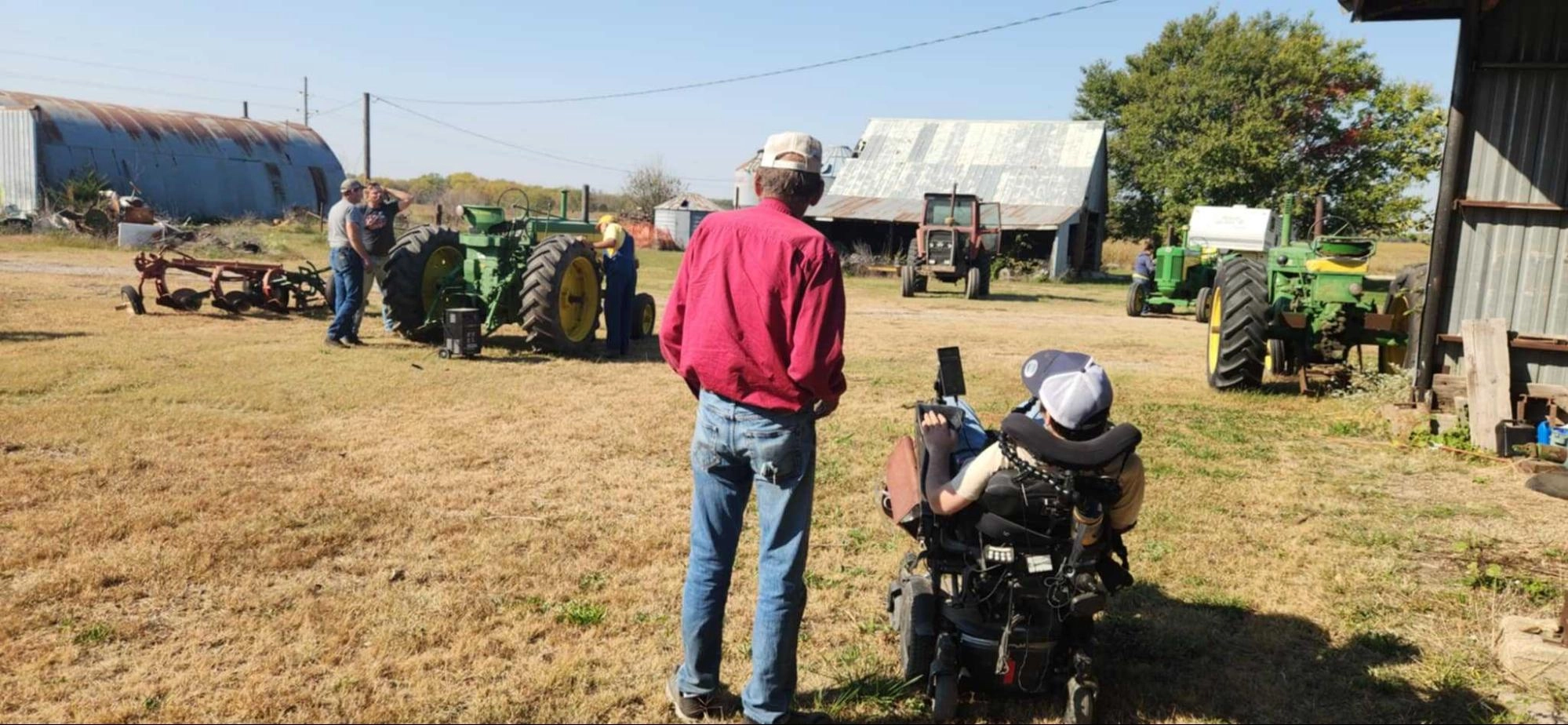
This year, Alex became the first participant to enroll in the CONVOY (Control of Assistive Devices Via Brain-Computer Interface Technology) Study,** a clinical trial exploring the feasibility of using the Link to control various assistive devices such as an Assistive Robotic Arm (ARA). ARA control expands autonomy beyond smart devices and could allow people with paralysis to perform tasks in daily life such as feeding themselves and handling physical objects. We will be providing updates on the CONVOY Study in an upcoming blog post.
Alex uses BCI to strum his guitar for the first time since his accident.
“It's such an amazing feeling being able to go from a concept to an actual working piece of equipment that does exactly what I want. I want everyone [disabled and non-disabled] to have the desire to create something new. Hopefully, I can inspire somebody to make a positive change in someone's life.”
— Alex
Brad
“The most significant thing that happened this week will sound strange to you: I got to use the computer on the porch, and it worked!!”
— Brad
Given his late-stage ALS, Brad is unable to speak or volitionally move any part of his body besides his eyes and the corners of his mouth. He has relied on an eye tracker to type letters as his only means of communicating. Unfortunately, the eye tracker is vulnerable to subtle shifts in eye position and nonfunctional in well-lit environments, preventing him from communicating when outdoors or in brightly lit indoor settings. Consequently, Brad is confined to staying indoors in darkness with the window blinds drawn.
Being unable to leave the house is challenging, especially for Brad who is a husband, a father of three children, an active member of his church, and an accomplished businessman.
With the Link, Brad has been able to communicate in a variety of environments by typing on his computer’s on-screen keyboard. This ability allows his family to turn on more lights in the house and, importantly, enables Brad to venture outside his home.
In just the past couple of weeks, the Link has enabled Brad to watch his son win a regional robotics competition, chat with neighbors at the park, and give a talk with a live Q&A session to the youth at his local church.
We’re currently working with Brad to design a communication system from the ground up by combining language models and novel neural decoding strategies. Our goal is to allow him to engage in conversations at a more natural speaking pace.
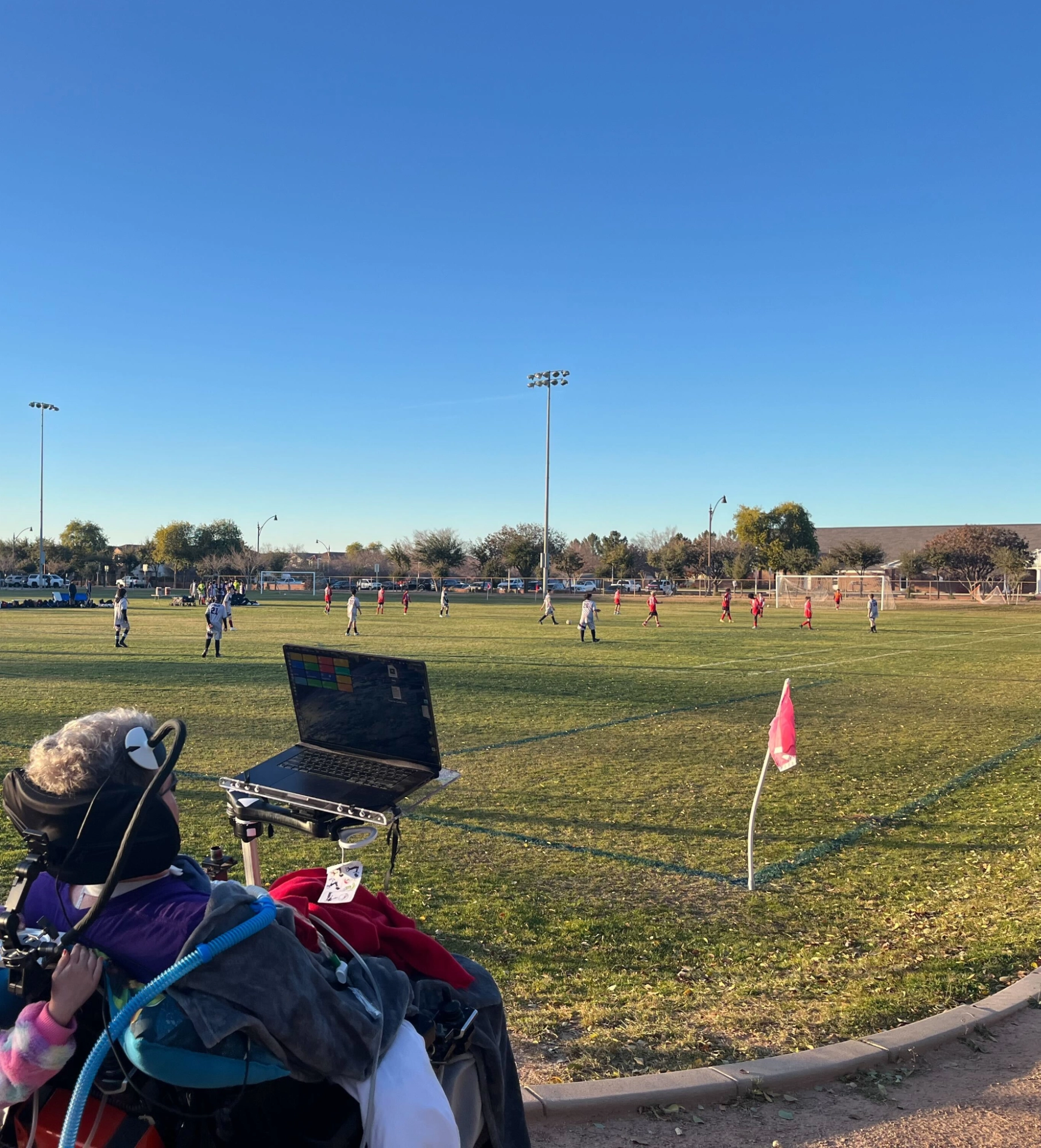
“I went to [my child’s] soccer game, and the referee thought I was sleeping. I was actually able to talk outside. I [am] actually thinking about traveling outside the [city] metro [for] the first time in 5 years.”
— Brad
Participate in a Neuralink Clinical Trial
“We’re just now scratching the surface of the capabilities and possibilities of this thing… I think down the road, it’s going to make a lot of people’s lives a lot better and make people much more independent and much more capable of doing a lot of things.”
— Noland (in New Mobility)
Our work with Noland, Alex, and Brad has shown encouraging potential for the Link to help restore autonomy to individuals with significant mobility impairments. Over the past year, they have provided invaluable feedback that has been instrumental in improving the design of our technology, ensuring it better meets the needs of future users.
We’re excited to work with more participants and their unique needs so that we can build and restore the functionalities that are most meaningful to them.
If you have spinal cord injury or ALS and are interested in helping shape the future of assistive technology by participating in a current or future Neuralink clinical trial, please consider joining our Patient Registry.
We have active trials in the United States and Canada and are connecting with people interested in potential future clinical investigations in the United Kingdom.
| Country | Locations | Clinical Trials |
|---|---|---|
United States | Barrow Neurological Institute University of Miami | PRIME CONVOY |
Canada | University Health Network | CAN-PRIME* |
United Kingdom | We do not have any active clinical investigations in the United Kingdom at the time of this post, however, those who are interested in learning whether they may qualify for future Neuralink clinical investigations in the United Kingdom may join our online Patient Registry. | |
If you are inspired by this update and interested in building technology that could restore autonomy to people with unmet medical needs, consider applying to one of our open roles.
* The PRIME Study and CAN-PRIME Study are investigational medical device trials for our fully implantable, wireless brain-computer interface (BCI) that aim to evaluate the safety of our implant and surgical robot and assess the initial functionality of our BCI for enabling people with quadriplegia to control external devices with their thoughts. We do not guarantee any benefit by participating in the PRIME Study or CAN-PRIME Study.
** The CONVOY Study is a clinical trial designed to explore the feasibility of participants from the PRIME Study using our implant to control various assistive devices. The main goal is to determine whether participants can successfully modulate their brain activity to control devices, such as an Assistive Robotic Arm (ARA). This study will assess the effectiveness, consistency, and safety of neural control using the ARA and other assistive devices. We do not guarantee any benefit by participating in the CONVOY Study. The CONVOY Study is being conducted at Barrow Neurological Institute and is anticipated to launch at the University of Miami later this year.